
How can government trust AI? Scaling public sector pilots into live services
How can we make AI trustworthy, practical, and scalable across the public sector? That was the key theme speakers and delegates explored during our recent event on scaling AI in government.
Government faces many challenges when adopting AI. Four years ago, the AI boom triggered departments to launch their own pilots but that initial momentum has stalled.
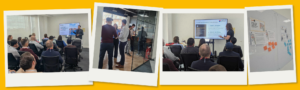
Hosted by Zaizi’s CEO, Aingaran Pillai, the event brought together colleagues from public sector organisations to discuss what it takes to move small-scale experiments into real public services.
Attendees had the opportunity to network, hear from expert speakers, and take part in interactive demos and workshops.
Scaling AI in government: Why do AI pilots struggle to progress?
Tommaso Spinelli, Service Owner for Cloud and Platforms at GDS and former lead on the UK Government AI Playbook, opened the discussion by outlining the UK’s AI ambitions.
Despite concerns in some quarters about the UK’s approach to AI regulation, Tommaso said the UK still ranks highly for government AI readiness and that AI is seen as an important driver of economic growth.
The initial flurry of government AI experimentation created valuable learnings but scaling from pilot to production has presented challenges.
“So when you try to scale AI, it faces challenges,” said Tommaso.
“It works in the lab, but when it meets the real world — which is made up of siloed data, poor data, fragmented organisations, lots of legacy technology and old APIs with all sorts of dependencies — there are problems.”
Building governance into AI
Governance and accountability were central themes throughout the event. AI brings risks such as hallucinations, bias and unexpected behaviour. Understanding and managing these risks early is crucial to operationalising AI.
“When you build AI, we need to make sure that the tools we are using are secure, safe, robust; they don’t have bias; they are ethically sound and fair; and that explainability and accountability are embedded into the tools. You need a clear mechanism for contestability and redress,” said Tommaso.
The government already has principles for responsible AI — such as the Introduction to AI Assurance and the AI Playbook.
But the problem is that AI is changing very quickly. That makes it difficult to create assurance processes that keep pace, added Tommaso.
Plus, government services can involve several different technologies working together. And that means assurance isn’t just about checking one AI model.
From “human in the loop” to “human in the lead”
Tommaso spoke about the importance of embedding deterministic guardrails directly into the system.
Having a human check AI output doesn’t work well when AI produces thousands of results or completes tasks on its own.
“The old idea of a ‘human in the loop’ should probably be switched to ‘human in the lead’, where the human sets parameters that are embedded within the technology that prevent the model from derailing,” said Tommaso.
Kickstart your AI project: Assess your organisation’s readiness, get your digital infrastructure in order, and select the right tools for the job
Neurosymbolic AI and its use in government
James, Head of Engineering for the AI team at Zaizi, looked at neurosymbolic AI and how it can help create AI systems government can trust.
The neuro part comes from neural networks. It’s what we normally think of as AI — things like chatbots, image/video generators, and computer vision models. These systems learn by looking at huge numbers of examples and finding patterns. They’re creative and flexible but unpredictable.
“It deals in plausibility, not truth. It generates things that look right, but that isn’t always what is actually right,” explained James.
Symbolic is predictable and explainable but less flexible. It uses a knowledge base of facts and predefined rules without guessing. Because the rules are set, you can see exactly why the system reached its conclusion.
“It deduces, it doesn’t guess, it doesn’t estimate,” said James. “The issue is these systems can’t think outside the box. If it’s given raw, messy, unstructured input, it can’t deal with that because it doesn’t fit with the rules that have been set.”
Combining flexibility with control
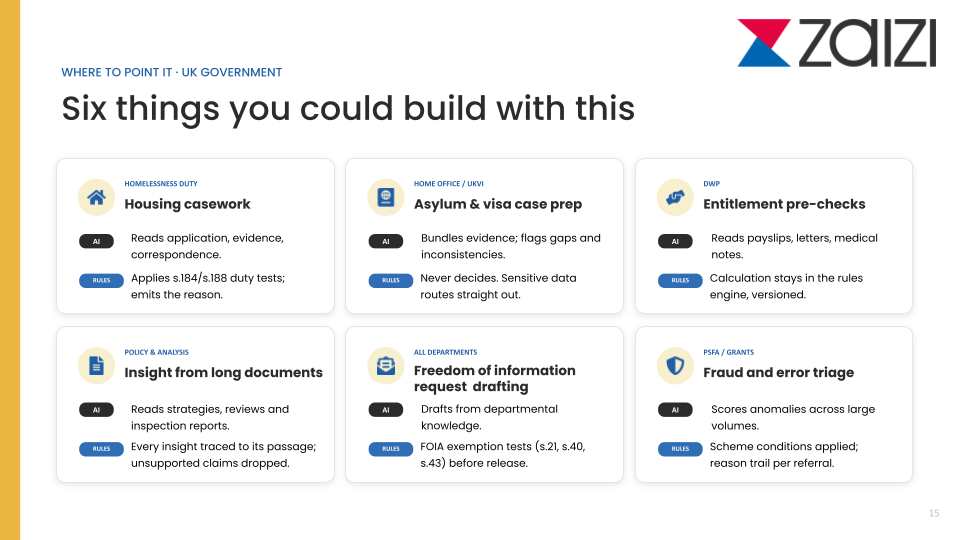
Neurosymbolic AI combines those two systems. “A neural network model drafts, reads the messy real-world data — letters, forms, photographs, freeform text — and proposes an answer,” explained James.
“A separate symbolic system applies rules to check against written facts, and anything that fails is refused or sent for human verification.
“If something is an edge case that can’t be solved by the system, it can be flagged, and there’s an audit trail that someone can trace through to see where it’s gone wrong.”
For government organisations, the appeal is building systems that can handle complexity while keeping control, checks and accountability. James demonstrated specific use cases where this approach could be applied, including:
- Housing casework
- Asylum and visa checks
- Entitlement pre-checks
- Making sense of long policy documents
- Freedom of Information requests
- Fraud and error detection
The breakout sessions
What trustworthy AI looks like in practice
In one breakout session, we showed how neurosymbolic AI can help government organisations pull reliable information from lengthy documents.
The system scans the document, extracts information, verifies it against the original document, and shows exactly where each insight comes from. Users can remove information they don’t consider accurate from the summary.
The discussion in the room highlighted that the tool’s value lies as much in provenance and traceability as in document summarisation.
Use cases included briefing materials, multilingual documents, and information that must remain traceable to its original source.
A key point was that the symbolic layer doesn’t need to remain static. Where policies or legislation change, you can update the knowledge base rather than retrain the entire model.
The principles of trustworthy AI in government
Breakout session two focused less on technology and more on how teams put AI into operation. Organisations need to answer the practical questions: where to set AI’s boundaries, who remains accountable, what must be made transparent, how to govern data, and how to maintain trust when moving to production.
We looked at several government case studies and the discussion highlighted some key takeaways:
- Keep humans involved where AI harm exists: If AI decisions materially affect someone’s life (as they can in defence or healthcare), a human needs to be in the decision-making process to weigh the ethical trade-offs.
- AI influences decisions, even when it doesn’t make the final call: How AI systems summarise and present information can sway human decision-making or cause people to passively “rubber stamp” decisions. Teams should design systems that let people understand and challenge AI recommendations.
- Who is responsible when an AI decision goes wrong? When a human makes a decision, they are individually accountable when something goes wrong. But when AI influences decisions, organisations need governance that clearly states who is responsible. Those affected by AI decisions should have ways to access their data and challenge decisions.
- Governance is everyone’s responsibility: Organisations should consider governance throughout the whole product lifecycle: design, development, deployment, and ongoing improvement. Responsibility relies as much on product, policy, and leadership teams as it does on technical teams.
From experimentation to production
Our event created a valuable space for government leaders to explore how to scale AI into trusted services.
The discussion emphasised that AI adoption is now about delivery, not just experimentation.
To do that, organisations need to think beyond the tech and consider legacy processes, service design, governance, assurance, and what happens when things go wrong.
At Zaizi, we deliver meaningful technical projects and help government organisations navigate some of those complicated, thorny assurance issues to get solutions out into the real world.
If you’d like to know more, please reach out to us using the contact form below.
Register and find out more about our next AI networking event, “Sovereign AI in government: Building secure, localised AI for public sector.“
Related content
-

From university to delivery: What our summer interns learned by solving a real public sector problem
-

What’s ‘human in the loop’ and why does it matter for government AI?
-
When machines go rogue: What the summer of AI agent chaos teaches us about engineering trust
-

The scaling problem: How government can finally operationalise AI
-

The Modern Government Podcast
-
Watch: From tool to actor — the rise of agentic AI