
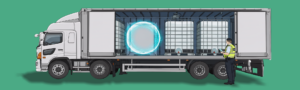
How Border Force explored AI for freight scanning in just 12 weeks
Customer overview
Border Force is a UK government organisation responsible for securing the nation’s borders by monitoring and controlling the movement of people and goods. It operates across airports, seaports, and rail hubs, balancing national security with the efficient flow of legitimate trade and travel, while preventing illegal activities such as smuggling, trafficking, and customs fraud.
At a glance:
- Zaizi helped Border Force explore how AI could enhance freight scanning by automatically detecting anomalies and contraband in X-ray images.
- In just 12 weeks, a proof of concept demonstrated AI models in real operational contexts, supporting officers to spot threats faster and more accurately.
- We’re working with Border Force to further develop the solution and lay the foundations for a business case to support wider AI implementation across Border Force operations.
The challenge
Faced with the growing complexity and volume of managing cargo flows across UK borders, Border Force wanted to improve efficiency and reduce the risks associated with manual work.
Zaizi had already helped Border Force modernise its port scanning operations with a globally acclaimed solution. We digitised and automated workflows, replacing manual, paper-based processes for freight scanning at UK seaports.
Building on this work, Border Force wanted to further improve the search and screening of vehicles entering ports with AI.
It sought to automate the detection of anomalies in X-ray images to help officers spot potential threats better, reduce errors, save time, and increase the volume of goods processed.
The client says…
“I think it’s fair to say that this was one of my first projects, which despite all the challenges, was absolutely delivered to time, cost and quality – a feat many project professionals are unable to claim,”
Chino Nwachukwu, previously Assistant Director of Border Transformation at Border Force.
The process
Through the ACE Framework, Zaizi joined a consortium exploring AI and machine-learning solutions for anomaly detection.
The consortium had already organised and analysed the Border Force’s X-ray image dataset, making it suitable for AI algorithm development.
Using the fully indexed and standardised data, Border Force worked with the consortium to identify and refine three main features with differing use cases:
- Vector integrity — used to spot hidden compartments, or false bottoms or sides, that might be invisible during a physical inspection.
- Pattern recognition — used to identify specific sorts of contraband (drugs, weapons, clandestines) in an image.
- High-density material detection — used to spot unusually dense areas of an image, such as a lead panel designed to conceal items during a scan.
We ensured the project included:
- clearly defined requirements, goals and use cases aligned to user needs.
- consideration of the end-to-end journey, operational challenges, and ethical implications in the solution design.
- use of pre-developed, tailored technology stacks to prototype quickly
- an agile approach with a small team to minimise costs, iterate rapidly, and refine models through rapid testing.
The results
In 12 weeks, a joint proof-of-concept demonstrated to Border Force how AI-powered vision models can detect contraband and highlight suspicious areas or threat probabilities in X-ray images.
Previous AI trials occurred under controlled conditions. As part of this work, AI tools were put in front of officers for the first time.
Zaizi also helped shape the implementation roadmap and guided Border Force through the governance, security, and ethical considerations necessary to progress from proof-of-concept to real-world operational trials.
Following the success of the trial, we’re working with Border Force to further develop the solution and eventually test in live environments.
The benefits
The project will lay the foundation for a business case for the wider implementation of AI across Border Force operations.
The work will deliver several key benefits to Border Force, which includes:
- reducing frontline officer workload by automating the analysis of scan images, minimising manual checks
- enhancing efficiency through faster processing of scans
- freeing officers’ time to focus on high-risk areas
- improving accuracy and detecting subtle anomalies that humans might miss
Read: How our user-centred approach won the trust of frontline officers at the borders
Next steps
Want to unlock better insight, faster reporting and a clearer path to responsible AI?
Speak to our team about running a discovery or Transformation Day to get started.
Other case studies
-
Exploring how AI takes the heavy lifting out of casework — A UK independent statutory body
-

Digital government: Building a better UK — Zaizi’s year in review
-

Enhancing care quality through data-driven insights and AI integration
-
Global award-winning customs innovation —Border Force
-

Our impact on digital government services in 2024
-
Helping local councils revamp taxi licensing to boost efficiencies and reduce costs