

Exploring how edge AI can overcome connectivity and security challenges in public services
- Our cross-functional AI delivery team looked at how Small Language Models (SLMs) on edge devices could support public sector services that need to work in areas with poor internet or where sensitive data must stay local. Edge AI devices make decisions locally, securely, without sending data to the cloud.
- We scoped a use case from an existing client and ran a six-week sprint. Our multidisciplinary team thought about the technical, operational, and user experience aspects to produce an offline AI translation solution.
- The internal experiment showed us that edge AI is a practical option for public sector bodies that need trusted AI solutions in high-security environments or places with limited connectivity.
The challenge
As concerns grow around digital sovereignty and reliance on foreign-controlled AI services, the case for SLMs on edge devices becomes increasingly compelling.
Recent developments in the AI landscape highlight the importance of resilience, portability and control. For public sector organisations, relying entirely on externally hosted AI services may introduce operational, commercial and sovereign risks that are worth considering as AI capabilities become embedded in critical services.
SLMs are a good alternative for government departments working in high-security environments, where data control is critical or internet access is unreliable.
With this in mind, our AI team wanted to test the possibilities of SLMs and edge AI.
To ground our research and development in a real-world context, we used a test use case from a public sector client. Note, this was a proactive internal learning project and not commissioned by the client.
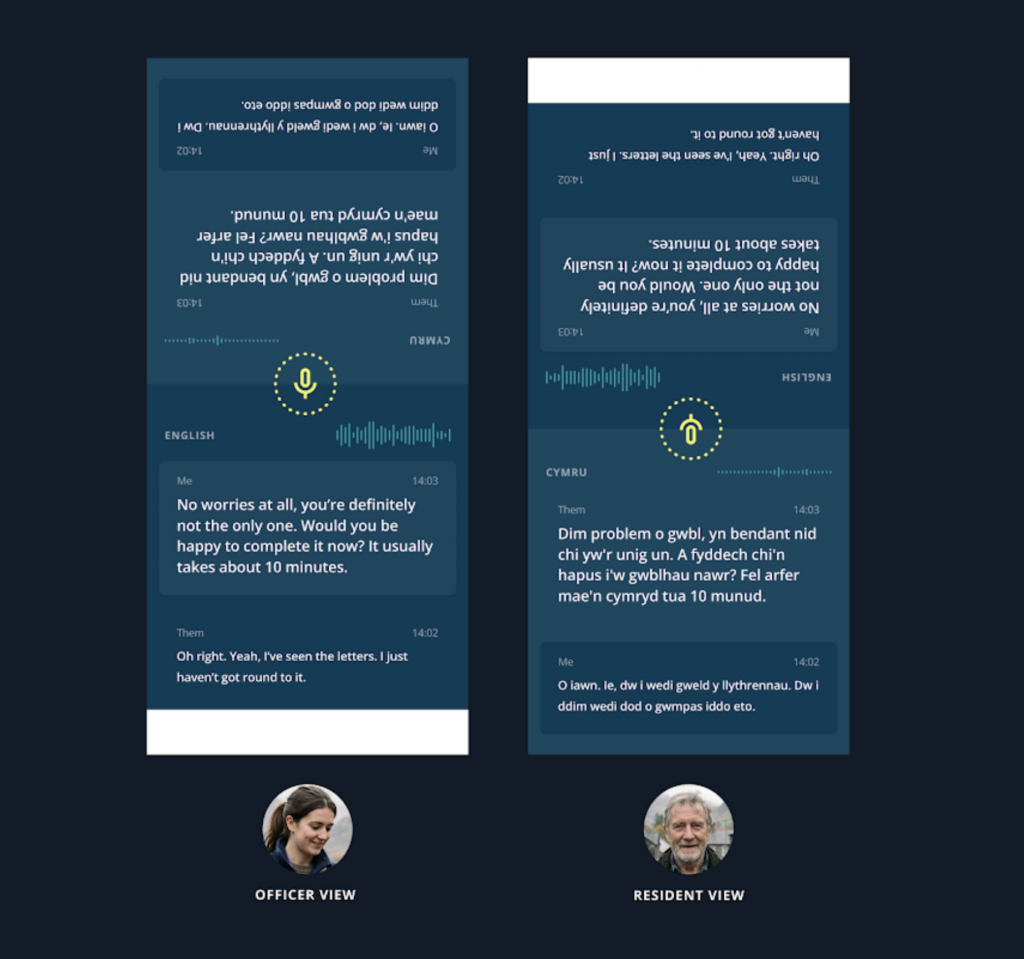
In the scenario, field officers visit rural households to help residents complete national surveys. In Wales, recruiting enough bilingual officers to do the job has always been difficult and online translation tools are not always practical due to poor connectivity in remote areas.
The use case provided a realistic operational scenario to explore how Edge AI could support frontline services, not only in this context but across a broader range of government challenges.
Our approach
Designing the user experience
Our multidisciplinary team looked at current Welsh translation tools and noticed the linguistic challenges associated with Welsh-English translation.
At the same time, translation accuracy alone would not determine success. Our research unearthed operational and usability constraints — any solution would need to work effectively in noisy environments, cope with different accents and dialects, meet accessibility requirements, and fit naturally into face-to-face conversations.
This shifted the focus from a simple technical problem towards a broader service design challenge.
In the design phase, we explored several approaches and concluded that trust, usability and operational simplicity were as important as translation accuracy.
The technical approach
The technical proof of concept focused on demonstrating whether modern SLMs could run effectively on edge devices.
The team:
- Built a React Native application capable of running across mobile platforms
- Identified and assessed available Welsh-language datasets
- Fine-tuned language models for English-to-Welsh translation
- Developed speech-to-text and text-to-speech capabilities
- Experimented with Welsh phoneme-based speech generation
- Tested support for regional Welsh variants
The results
Within six weeks, the project delivered:
- A working mobile proof of concept
- User interface designs
- Offline language model inference
- English-to-Welsh translation capability
- Speech to speech and speech to text workflows, captured as user journeys
- Research into confidence scoring and human oversight approaches
- A detailed assessment of operational, linguistic and technical challenges
What we learned
Several broader lessons emerged that may be relevant to organisations exploring operational uses of AI:
- Edge AI is becoming increasingly practical. We demonstrated language model inference on relatively modest hardware, showing that specialised AI workloads no longer require significant cloud infrastructure.
- Access to high-quality data is key. Gathering sufficient Welsh conversational data, speech recordings and dialect coverage proved more challenging than model development itself.
- User trust is an essential factor. Questions around confidence scoring, verification and human oversight emerged almost immediately. The challenge was not simply producing a translation; it was helping users know when they could trust it.
Next steps
Although the use case for this project was for a lightweight AI translation service, the experiment revealed broader opportunities for edge AI in government services.
For example, future applications include:
- Frontline public service interactions in low-connectivity environments
- Secure and high-side operational environments
- Multilingual support tools
- Educational and language-learning applications
- Humanitarian and field-based services
- Freedom of Information (FOI) & Subject Access Requests (SARs)
- Intelligent ingestion & automated case triage
If your organisation is facing similar challenges with field operations, data sovereignty, or seeking to adopt secure AI capabilities in low-connectivity or high-security environments, we’d love to share our findings. Get in touch using the form below
Other case studies
-

Modernising legacy compliance processes for government records management
-

Replacing manual asylum case reporting with a shared government digital service
-

Modernising critical legacy systems without disrupting services — The National Archives
-
Exploring how AI takes the heavy lifting out of casework — A UK independent statutory body
-
How Border Force explored AI for freight scanning in just 12 weeks
-

Digital government: Building a better UK — Zaizi’s year in review