

Replacing manual asylum case reporting with a shared government digital service
Customer overview

The Home Office is responsible for managing the UK’s asylum system, including asylum support, accommodation services and the transition of individuals into local community services following a positive asylum decision.
A critical part of this process is the move-on period, where individuals transition from Home Office accommodation and support into Local Authority services within a defined timeframe.
At a glance:
- Time-sensitive operational processes involving multiple organisations
- Large volumes of case data managed across fragmented systems
- High reliance on manual reporting and spreadsheet-based coordination
- Critical safeguarding and accommodation pressures linked to move-on delays
- Multiple stakeholders including Local Authority caseworkers, asylum transformation teams and rough sleeping support services
The challenge
The existing asylum move-on process relied heavily on manually created spreadsheets, disconnected systems and reactive communication between the Home Office and Local Authorities.
This created delays in sharing important case information and limited Local Authorities’ ability to prepare for individuals approaching the move-on period. Without early visibility of estimated support end dates and case progression, teams were often forced into reactive crisis management.
The process also created significant operational friction. Staff spent large amounts of time reconciling data, managing email chains and validating information across multiple sources. These coordination challenges contributed to delays in accommodation flow and increased dependency on temporary hotel accommodation.
Key challenges included:
- Manual spreadsheet-based reporting processes
- Fragmented visibility of asylum case data
- Delayed communication between organisations
- High administrative burden for operational teams
- Limited ability for Local Authorities to plan proactively
- Increased reconciliation effort and duplicated work
- Accommodation delays linked to reactive case management
The client says…
“Home Office reputation, engagement, relationship – that’s really key. We could baseline what the confidence is in us providing accurate data and our relationship and reliability…”
Operational stakeholder feedback
Our solution and process
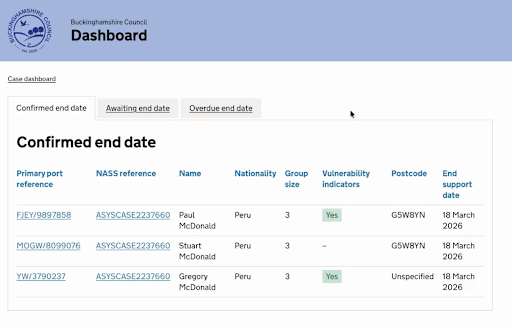
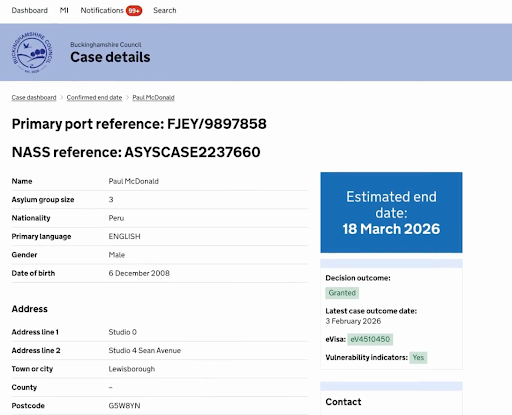
Zaizi worked with the Home Office to design and test a cloud-native dashboard that improves visibility of asylum move-on activity and creates a more consistent operational view across organisations.
Our multidisciplinary team spanning product, user-centred design, cloud engineering and data worked collaboratively with stakeholders to understand operational pain points and test potential solutions through iterative prototyping and user research.
The proof of concept, focused on replacing manual spreadsheet reporting with a single trusted operational view that supports earlier planning, faster coordination and improved data confidence.
We carried out multiple rounds of usability testing and coded prototypes, helping refine the service around real user needs and operational workflows.
The architecture was designed using AWS EKS Fargate and incorporated a Medallion Pattern approach to support data quality, scalability and future AI integration opportunities.
Key activities included:
- Discovery and proof of concept delivery
- User research and usability testing with Local Authority users
- Coded prototype development
- Collaborative workshops with operational stakeholders
- Cloud-native dashboard design and development
- Data architecture and integration planning
- Development of a trusted operational visibility layer
- Exploration of future AI-enabled operational opportunities
The results
- Faster case assessment activity – Usability testing indicated potential time savings of around 30 minutes per standard case assessment and more than three hours for complex cases.
- Reduced operational administration – The shared dashboard reduced reliance on manual spreadsheets, duplicated reporting and long email chains between organisations.
- Improved visibility for Local Authorities – Earlier access to estimated support end dates helped Local Authorities prepare sooner for asylum case transitions and potential safeguarding needs.
- Strong user adoption potential – Local Authority officers rated the platform’s ease of use at an average of 4.5 out of 5, indicating low training requirements and strong operational usability.
- Potential reduction in accommodation pressures – Improved coordination and earlier intervention created the potential to reduce prolonged hotel stays. Initial modelling suggested that reducing average hotel stays by five days could save approximately £4 million annually.
The benefits
1. Earlier planning for Local Authorities
Providing earlier visibility of asylum case activity helps Local Authorities prepare resources, engage individuals sooner and reduce reactive crisis management.
2. Simpler cross-organisation working
Replacing fragmented spreadsheets and disconnected reporting processes creates a more consistent and manageable workflow across teams.
3. Greater confidence in operational data
A single, trusted view of case information improves decision-making and reduces time spent validating data across multiple systems.
4. Scalable foundations for future improvement
The cloud-native architecture creates a flexible platform that can support future automation, integration and AI-enabled operational services.
Read: An AI readiness roadmap for decision makers
Facing similar challenges?
If your teams are managing manual processes, fragmented systems or operational bottlenecks, we can help you identify a practical path forward.
Explore how Zaizi helps government organisations modernise legacy services, improve operational visibility and reduce administrative burden.
Related case studies:
- Modernising public records compliance across government
- Using automation to improve Border Force operations
- Replacing manual workflows with legacy modernisation
Next step:
Book an AI & Digital Acceleration Workshop to map your challenges, identify quick wins and explore safe modernisation opportunities.
Other case studies
-
Exploring how edge AI can overcome connectivity and security challenges in public services
-

Modernising legacy compliance processes for government records management
-
Modernising critical legacy systems without disrupting services — The National Archives
-
Exploring how AI takes the heavy lifting out of casework — A UK independent statutory body
-

How Border Force explored AI for freight scanning in just 12 weeks
-

Digital government: Building a better UK — Zaizi’s year in review